

Author
Jonathan Hobbs, CFA
Date
05 Nov 2026
Category
Market Insights
IncomeShares Strategy Update: What's Changing and Why
Your capital is at risk if you invest. You could lose all your investment. Please see the full risk warning here.
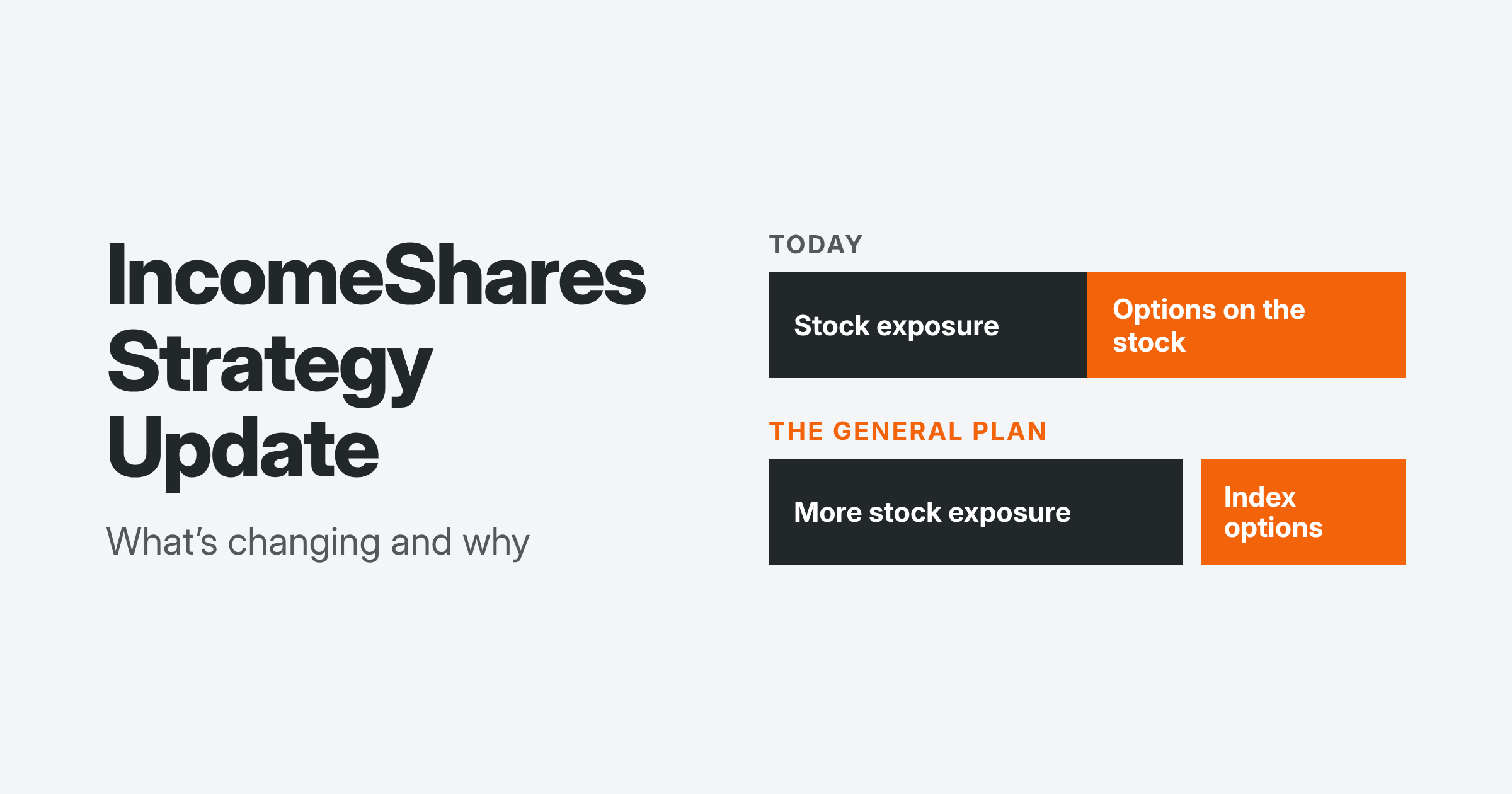
This IncomeShares strategy update explains what we're changing in our put-selling ETPs (exchange-traded products), and why. On 29 October, we published a notice that lets our ETPs sell options on stock indices too. The aim is to help each ETP capture more of its underlying asset's rise, while still paying monthly income. This article explains what's changing, why we're doing it now, and what it means for investors.
What's changing in the IncomeShares strategy update
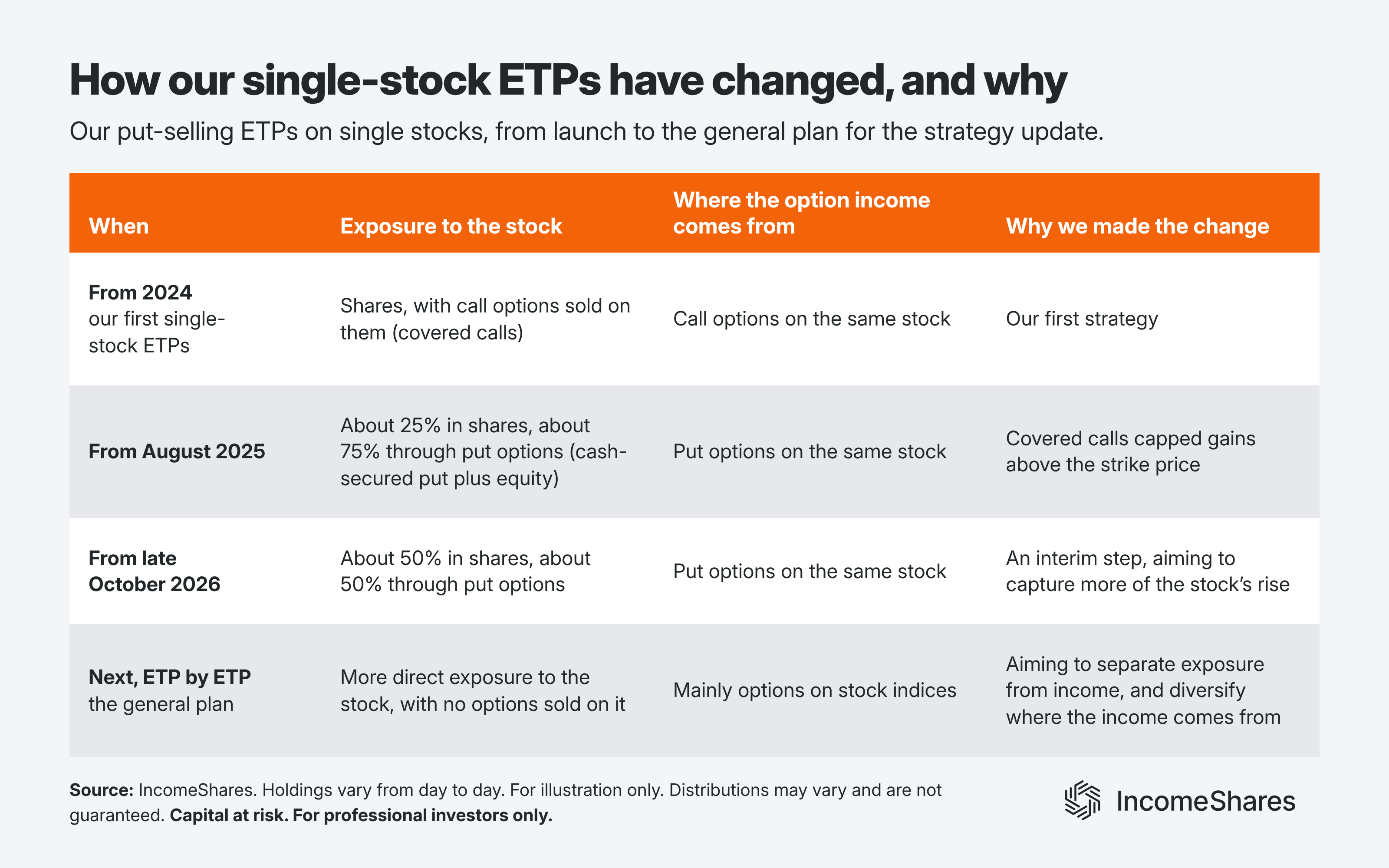
Most of our ETPs hold a single stock and sell put options on it. Since August 2025, they've used a cash-secured put plus equity strategy. Our Tesla Options ETP, for example, held Tesla shares for about 25% of its exposure. It got the other 75% by selling put options on Tesla (a cash-secured put). The option buyers pay a fee up front (a premium), which goes towards the income we aim to pay.
In late October, we raised the direct exposure across our put-selling ETPs to about 50%. Put options made up the rest. That was a first step, aiming to capture more of each asset's rise while we prepared the bigger changes below.
The general plan is to go further, ETP by ETP. Each ETP would have more direct exposure to its underlying asset, with no options sold on that exposure. Most of its option income would then come from options on stock indices (like the S&P 500 and Russell 2000). The image below shows the difference.
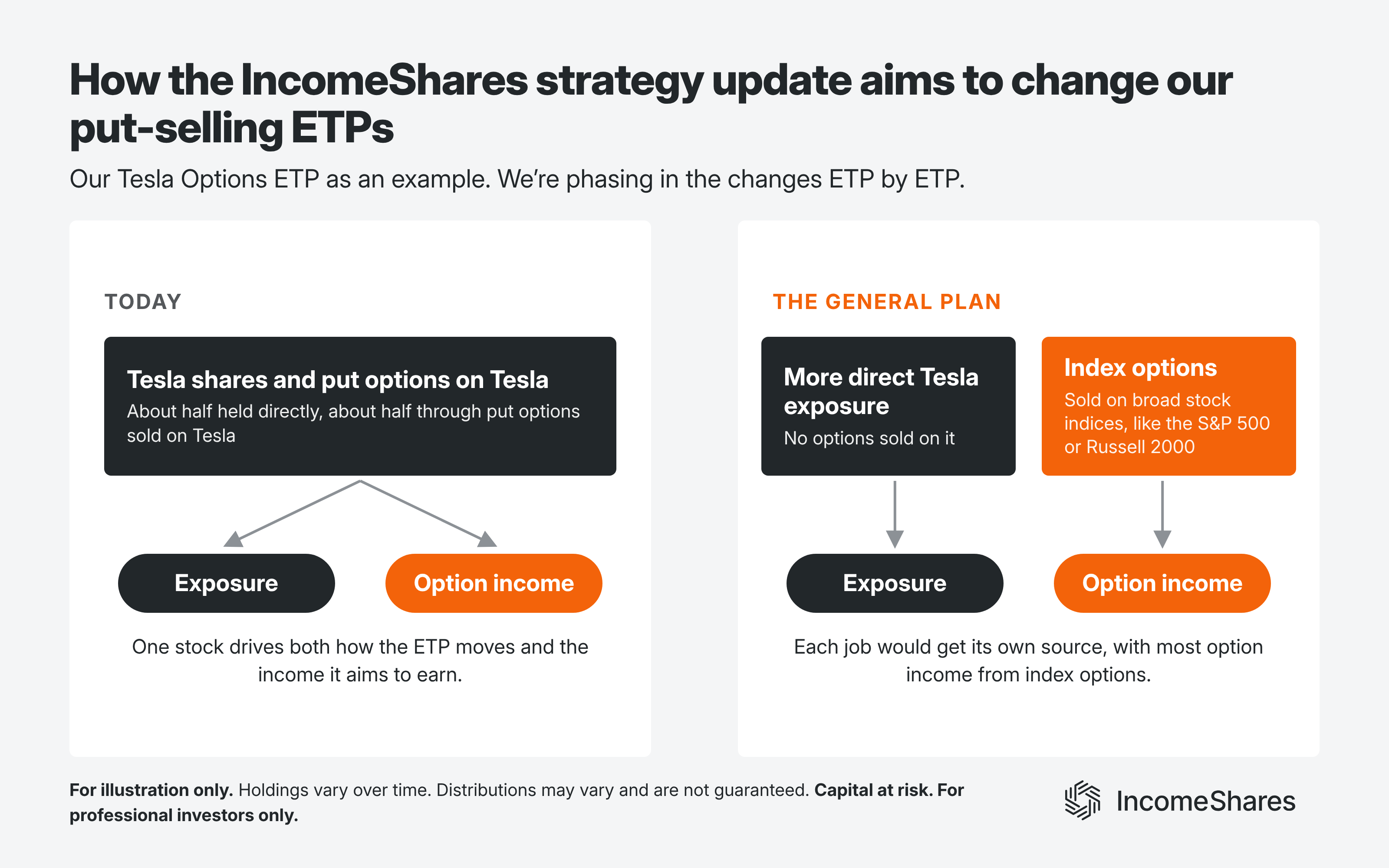
The S&P 500 covers about 500 companies, and the Russell 2000 about 2,000. So options on them may help diversify the risk behind the income, rather than tying it to one stock. Those options also add some index exposure, so the ETP can lose money on them if the index falls.
But an index and a stock don't move in lockstep (Tesla can rise when the S&P 500 falls). Together, the direct exposure and index options aim to give each ETP exposure closer to its underlying asset's moves. And we still aim to pay monthly income.
Our S&P 500 and Nasdaq 100 ETPs work the same way, but on an index instead of a single stock. Under the general plan, each would hold more direct exposure to its own index. Some of that may come from futures (agreements to buy the index at a set price on a set date). These let the ETP keep more of its money in cash. Most of its option income would then come from options on a different index (like the Russell 2000). Two indices don't move in lockstep either, so this may still help diversify the risk behind the income.
Why we're making these changes
In our October investor survey, 80% said they'd take a bit less income for more of the underlying asset's rise. And 78% want an ETP that moves roughly in line with its underlying asset. We'd already started work on these changes before the survey, but its results generally backed up what investors had told us.
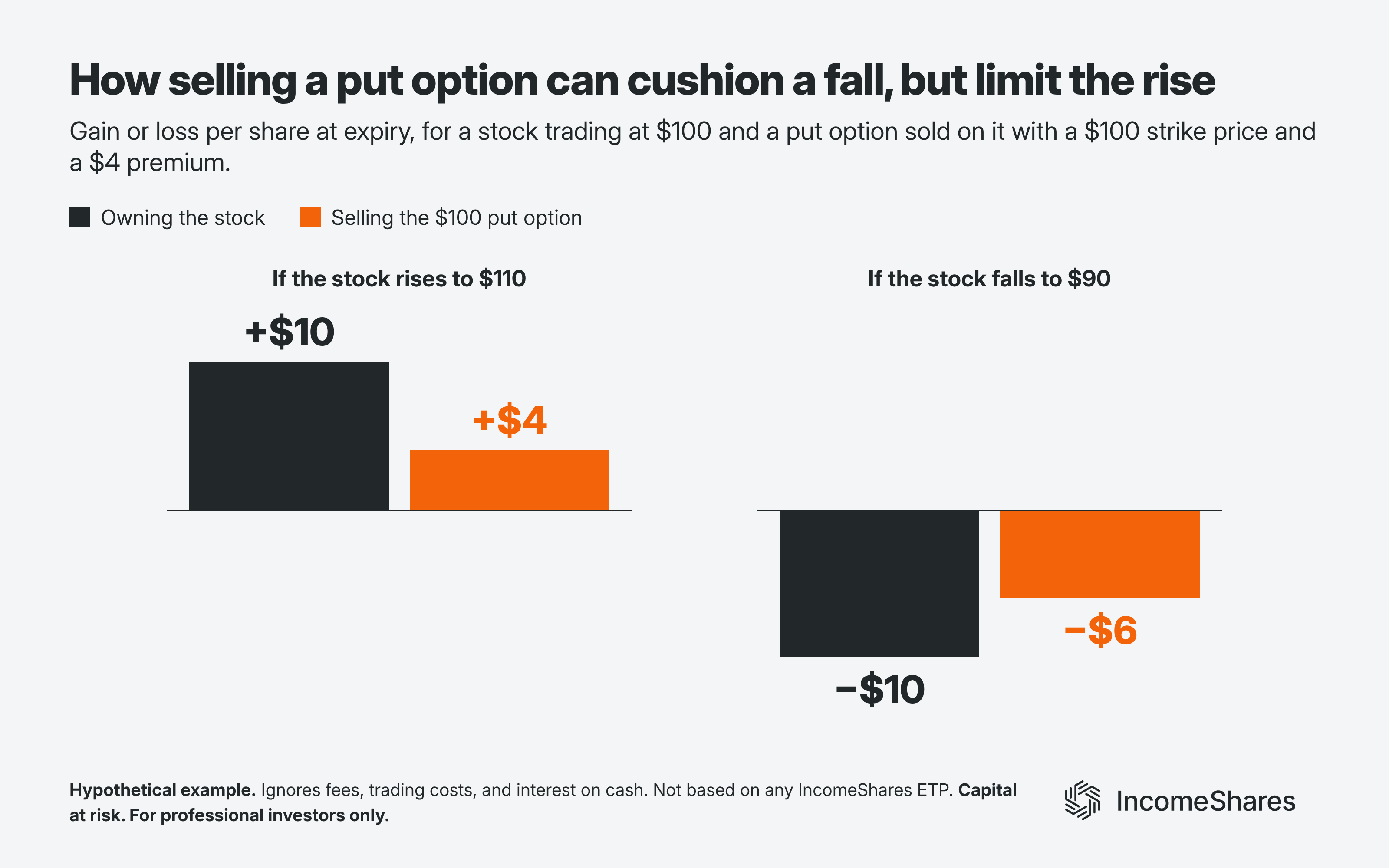
An options income ETP can lag its underlying asset in a rally because of how selling put options works. When you sell a put option, you don't own the stock. You agree to buy it at a set price (the strike price) if the buyer wants to sell it. So you take on most of a fall in the stock. But in a rise, your gain is limited to the premium. Suppose a stock trades at $100, and you sell a put option on it with a $100 strike price. The buyer pays you a $4 premium up front for that right.
If the stock rises to $110: the buyer won't sell it to you at $100, so the option expires worthless. You keep the $4 premium, while the stock gained $10.
If the stock falls to $90: you have to buy it at $100. That's a $10 loss, or $6 after the premium, while the stock lost $10.
So the premium cushioned part of the fall, but you missed most of the rise. The chart below shows both. That's why our put-selling ETPs also hold shares, which can capture a rise. But the more an ETP relies on put options rather than shares, the less of a rally it may capture.
What we found across 134 single-stock options income funds
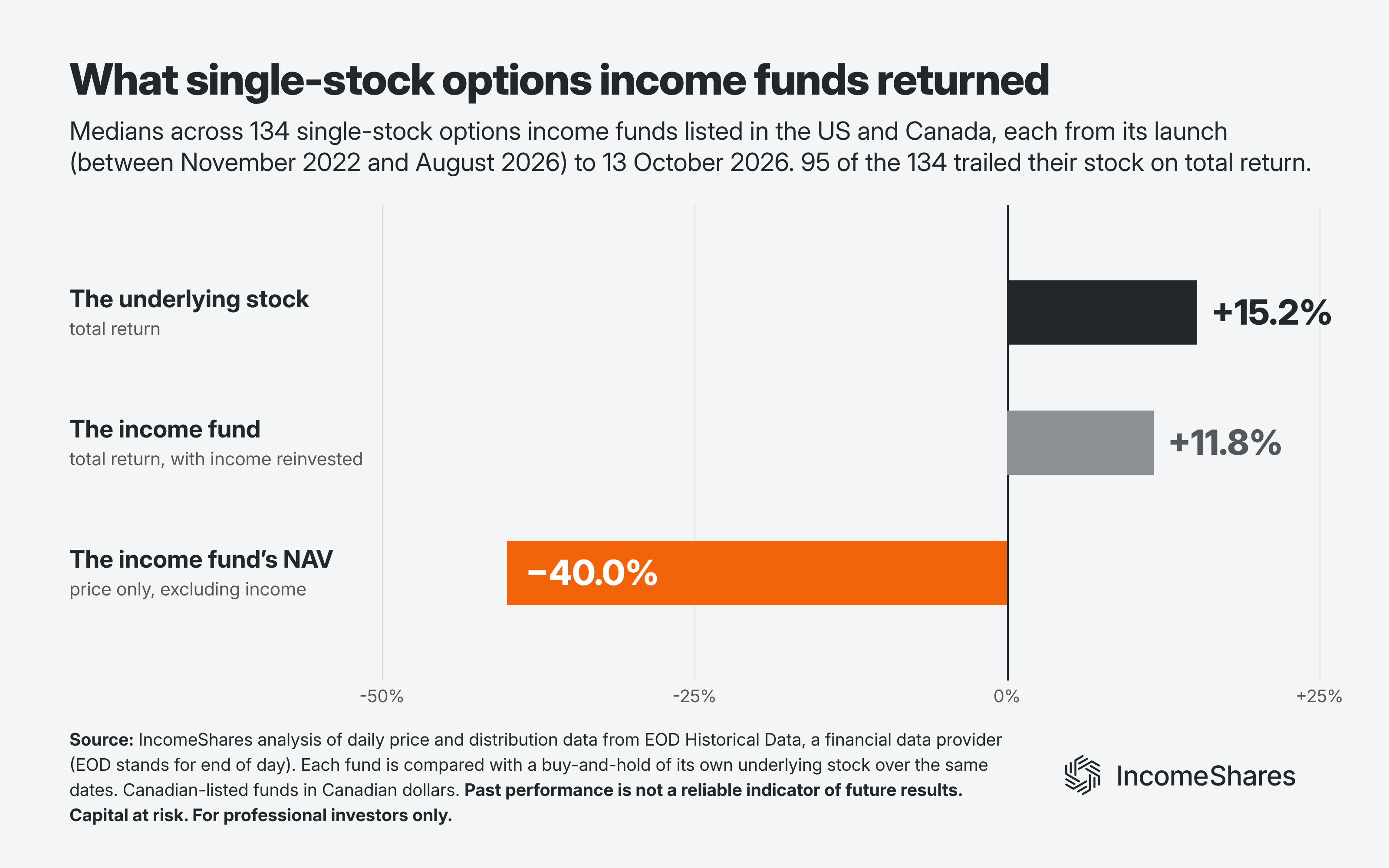
We also studied 134 single-stock options income funds from eight issuers in the US and Canada. We compared each fund with its stock from its launch to 13 October 2026, when we ran the study. The funds launched between November 2022 and August 2026, and half had been running for less than a year.
Data: daily prices and distributions from EOD Historical Data, a financial data provider (EOD stands for end of day). All figures are medians (the middle fund), so a few extreme funds don't skew them.
With income reinvested, the median fund's total return was 11.8%, while the stocks' own median total return was 15.2%. In all, 95 of the 134 funds trailed their stock on a total return basis. Their net asset value (NAV) did worse, with a median NAV return of -40.0%. And 108 of the 134 had a lower NAV than at launch, as the chart below shows.
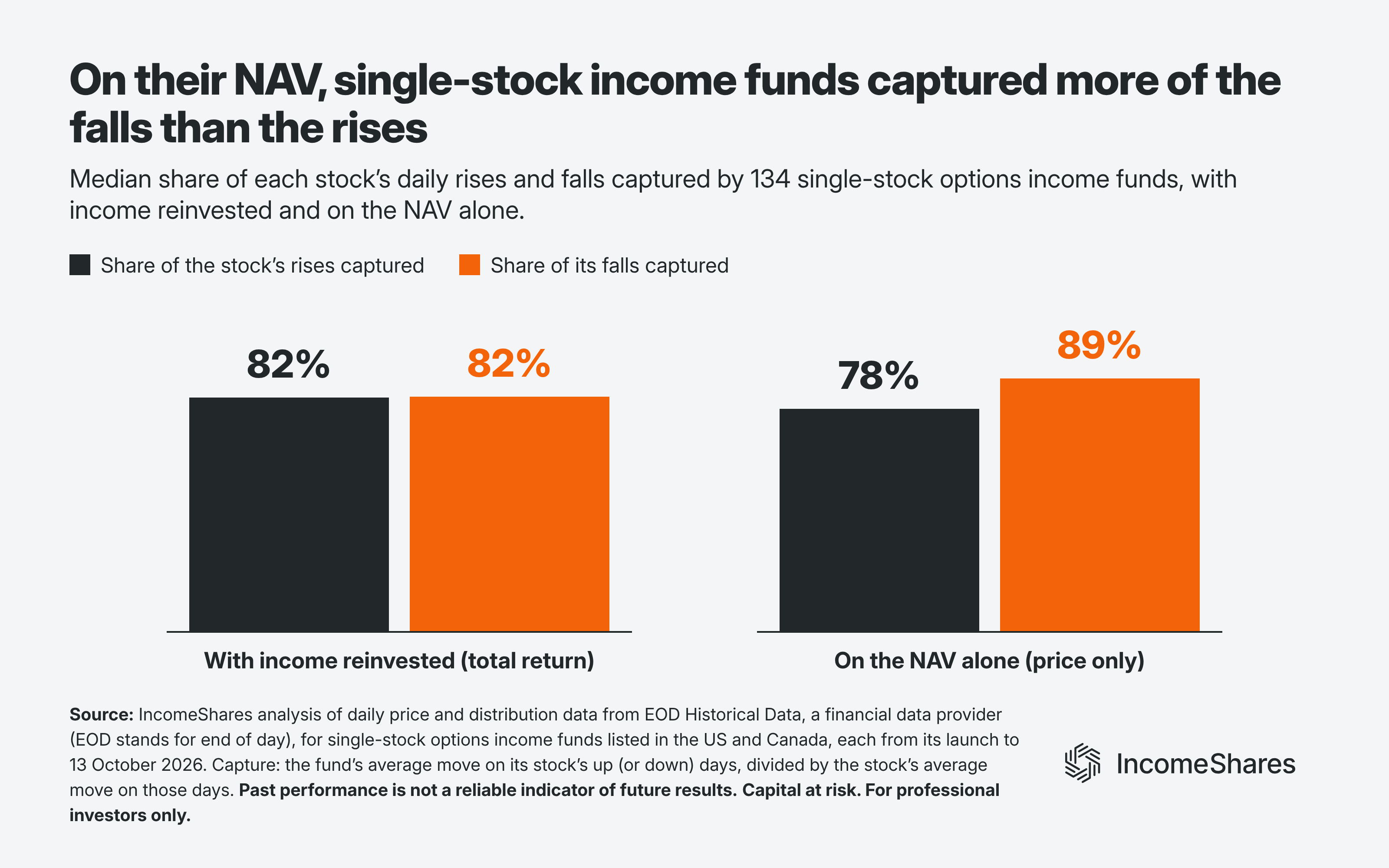
Part of that NAV fall comes from the income itself, since each payout lowers a fund's NAV. But on their NAV, the funds also captured 78% of their stock's rises, against 89% of its falls. With income reinvested, they captured 82% both ways, as the chart below shows. Over time, that uneven capture on the NAV can add to NAV erosion.
Why we're making these changes now
As the table below shows, our single-stock ETPs have changed twice since we launched the first ones in 2024. Each time, the aim was to capture more of each stock's rise, while still aiming to earn option income.
There are three reasons we're only making these changes now.
First, our ETPs weren't allowed to sell options on other assets before. Until 2 November, each ETP could only sell options on its own underlying asset. And its put options had to have a strike price at or above the asset's market price. The 29 October notice changes that from 2 November.
Second, finding the right approach took time. We've run the cash-secured put plus equity strategy for over a year, and studied other options income funds. We then backtested different approaches on each ETP's underlying asset (testing how they might have worked on past data). That helped us find the approach we think may work best.
Third, the market makers that quote buy and sell prices for our ETPs need time to adjust to each change. So we’re phasing in the changes ETP by ETP, rather than switching every ETP on one day.
What the IncomeShares strategy update means for investors
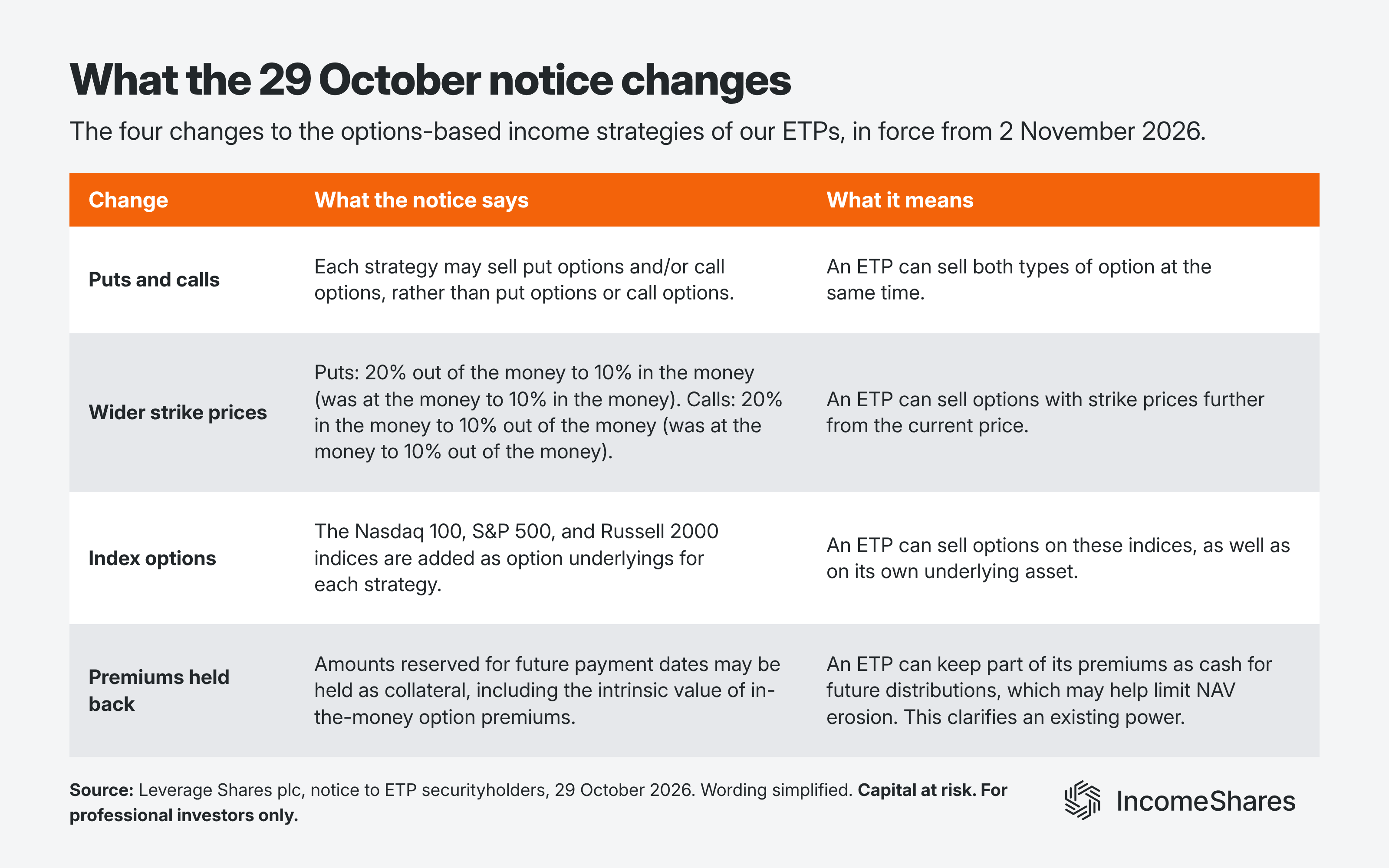
The 29 October notice gives our ETPs more flexibility in how they earn option income. It sets out what each ETP can do – not what it will do straight away. The table below explains the four changes.
Each ETP can now sell put and call options together, and use a wider range of strike prices. It can also sell options on the Nasdaq 100, S&P 500, and Russell 2000. And it can keep part of its option premiums as cash, to help pay future distributions.
That last change may help limit NAV erosion. Part of an in the money option's premium is its intrinsic value (what it's already worth to the buyer). The ETP may need that money to cover the option, so holding it back may help protect the NAV.
We plan to phase in the changes ETP by ETP, and the details may change as we go. Each ETP's product page shows its current holdings.
We still aim to pay monthly income distributions. But their size may change as each ETP moves over, since index options can earn different premiums. The new approach also brings different risks:
If the index falls, the ETP can lose money on its index options, even if its underlying asset holds up.
In a broad market sell-off, the index and the ETP's underlying asset can fall at the same time.
With more direct exposure to its underlying asset, the ETP can also capture more of its falls.
IncomeShares strategy update: frequently asked questions
What is the IncomeShares strategy update?
Our put-selling ETPs aim to have more direct exposure to their underlying asset, with no options sold on that exposure. Most of their option income would then come from options on stock indices, instead of on their own underlying asset. The aim is to capture more of the underlying asset's rise, while still paying monthly income.
Why are you making these changes?
Investors have told us they want more of the underlying asset's rise, not just income. An ETP that sells put options on its own underlying asset can miss most of a rally on those options. More direct exposure to its underlying asset aims to help with that.
Why are you only making these changes now?
Until 2 November, our ETPs could only sell options on their own underlying asset. Finding the right approach also took time. We ran our cash-secured put plus equity strategy for over a year, studied other funds, and backtested different approaches. That helped us find the approach we think may work best. The market makers that quote our ETPs' prices also need to follow each change, so we're phasing it in.
Which ETPs are changing?
Our put-selling ETPs, like our single-stock ETPs and our S&P 500 and Nasdaq 100 ETPs. Our basket ETPs, like our Magnificent 7 Options ETP, hold other IncomeShares ETPs. So they may change as those ETPs do.
Are the Gold+ Yield, Silver+ Yield, and 20+ Year Treasury Options ETPs changing?
Not for now. These three ETPs sell covered calls, and we're focusing on our put-selling ETPs first. We can't rule out changes later, but if anything changes, we'll let you know.
Do I need to do anything?
No, you don't need to take any action. Your ETP shares stay the same, and the changes happen inside each ETP.
When will my ETP change?
We plan to phase in the changes ETP by ETP, and the details may change as we go. Each ETP's product page shows its current holdings.
How much direct exposure will each ETP have to its underlying asset?
It may differ from ETP to ETP, and change as we phase in the changes. Each ETP's product page shows its current holdings.
Will my monthly income change?
We still aim to pay monthly income distributions. But their size may change as each ETP moves over, and with market conditions. We'll keep publishing each month's distributions as usual.
Will index options earn lower premiums?
Often, yes. An index usually moves less than a single stock, so options on it tend to earn smaller premiums. But an in the money put option's premium isn't all income. Part of it is intrinsic value, which the ETP may need to cover the option. In our October survey, 80% said they'd take a bit less income for more of the underlying asset's rise.
Does the new approach bring new risks?
Yes. If an index falls, the ETP can lose money on its index options, even if its underlying asset holds up. And with more direct exposure to its underlying asset, the ETP can also capture more of that asset's falls.
Will the ETPs use futures?
Some may, mainly for index exposure. That doesn’t make them leveraged ETPs. Each one aims to give exposure to its underlying asset, not a multiple of its daily move.
Why the Russell 2000?
The Russell 2000 covers about 2,000 smaller US companies. Big tech companies make up a large part of the S&P 500 and Nasdaq 100. So the Russell 2000 doesn't move in lockstep with them. Smaller companies also tend to move more than big ones. That means options on the Russell 2000 tend to earn higher premiums than options on the S&P 500.
Has the new approach been backtested?
Yes. We backtested different approaches on each ETP's underlying asset, to find the one we think may work best. But a backtest uses hypothetical trades on past data. That isn't a reliable indicator of future results, so we're not publishing the results.
What did the 29 October notice change?
It lets each ETP sell put and call options together, and use a wider range of strike prices. Each ETP can also sell options on the Nasdaq 100, S&P 500, and Russell 2000. And it confirms each ETP can keep part of its option premiums as cash, to help pay future distributions.
Key highlights
This IncomeShares strategy update aims to help our put-selling ETPs capture more of their underlying asset's rise. We still aim to pay monthly income.
The plan is to give each ETP more direct exposure to its underlying asset, and earn most option income from stock indices.
We're phasing in the changes ETP by ETP. Index options may help diversify the income, but the ETP can lose money on them if the index falls.
Your capital is at risk if you invest. You could lose all your investment. Please see the full risk warning here.
Related Products:

Strategy
Cash-Secured Put + Equity
Distribution Yield
52.80%

Strategy
Cash-Secured Put + Equity
Distribution Yield
38.17%

Strategy
Cash-Secured Put + Equity
Distribution Yield
42.76%

Strategy
Cash-Secured Put + Equity
Distribution Yield
23.13%

Strategy
Cash-Secured Put + Equity
Distribution Yield
42.10%

Strategy
Cash-Secured Put + Equity
Distribution Yield
44.64%

Strategy
Cash-Secured Put + Equity
Distribution Yield
29.54%

Strategy
Cash-Secured Put + Equity
Distribution Yield
50.40%

Strategy
Cash-Secured Put + Equity
Distribution Yield
26.46%